
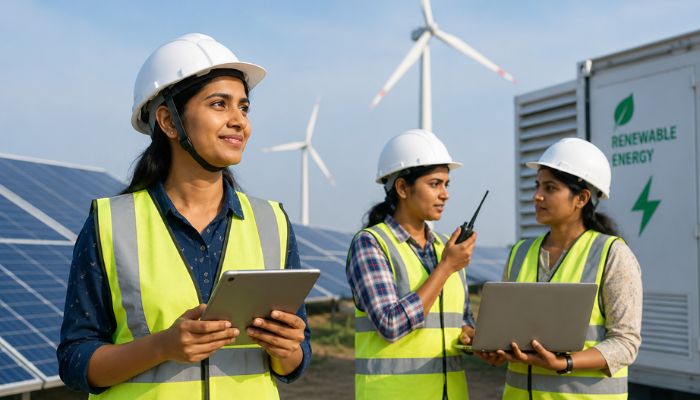
India’s shift towards a green economy is gathering pace. National missions linked to net zero 2070, the 500 GW clean energy target by 2030, and large investments in electric mobility, hydrogen, batteries, and energy storage are moulding how industries grow and how jobs are created. Across states, new solar parks, EV plants, and renewable energy projects are coming up at a steady pace. This expansion is not only about technology. It is about people who will build, operate, and maintain this new economy.
Estimates suggest that the green transition could generate up to 35 million jobs by 2047. These opportunities will span technical, operational, and knowledge-based roles across sectors. Yet the supply of skilled talent is not keeping up with the pace of investment. Less than 10% of young people are formally trained for emerging green roles. Many enter the workforce with a basic education but without the practical skills needed for these new industries.
The challenge is becoming clearer. The real constraint is not policy. It is not capital. It is the absence of a structured and reliable talent pipeline that can prepare young people for green jobs at scale.
The Real Gap: Education, Curriculum, and Faculty Readiness
Green jobs require a mix of skills that traditional education pathways have not fully adapted to. These roles demand understanding of STEM basics, digital systems, safety standards, and sustainability science. Workers must be able to handle equipment, follow compliance rules, and work with data and monitoring systems.
At present, the education system is still catching up. Climate technology courses are limited. Many institutions lack trained faculty who understand green technologies in depth. Lab infrastructure that supports hands-on learning is also weak in many parts of the country. Students often learn theory, yet they get very little exposure to how green systems work in real settings.
As industries expand, demand for these skills is rising faster than the skilling ecosystem can respond. This gap is creating pressure on employers who have to train new hires from the ground up before they become productive.
The Missing Talent Architecture: Academia-Industry Integration
One of the biggest challenges is the lack of strong alignment between academia and industry. Curricula are often not designed with real job roles in mind. Training pipelines remain limited. Practice-based learning models are still not a common part of most programs.
To address this, there is a growing need for apprenticeship-embedded programs, credit-linked certifications, and industry co-designed modules. These approaches can help bridge the gap between learning and work. Green roles require hands-on capability in areas like electrical systems, digital monitoring, safety practices, and environmental compliance. These are skills that can only be built through real exposure.
At present, much of the skilling remains too theoretical and fragmented. Students learn concepts, but do not always get the chance to apply them. Without strong integration, industries continue to face a shortage of job-ready talent even as opportunities grow.
Innovation, R&D, and Private Investment as Talent Catalysts
Talent tends to grow where innovation thrives. Regions with strong research centres, startup ecosystems, and industry investment often see faster skill development. The same pattern is now visible in the green economy.
Priority areas such as hydrogen research, battery chemistry, ESG analytics, and climate technology are beginning to create new learning and career pathways. Research hubs and private investments are not only creating products. They are also building the next generation of skilled professionals.
When companies invest in R&D and set up innovation centres, they create environments where young people can learn by working on real problems. Over time, these hubs become anchors for talent supply. They attract students, support training, and strengthen the link between education and employment.
Even as investments and innovation gather pace, the availability of skilled talent remains a growing concern across the green economy. Globally, employers report a visible shortage of workers with green skills, with demand expected to outpace supply by a significant margin over the coming decade. India faces a similar reality.
Women as the Workforce Multiplier
In this context, women represent one of the largest untapped talent pools in India’s workforce. Today, women are 48% of the population but contribute only 18% to our GDP. In the green economy, they can play a key role in scaling capacity across sectors. From solar installation support roles to data analysis in ESG functions, opportunities are expanding across different skill levels.
Structured entry pathways make a visible difference. When women have access to safe, stable, and guided learning environments, retention improves. Productivity rises. Teams become more stable. Over time, these workers move into more responsible roles.
Apprenticeships can support this shift by opening doors to technical, operational, and analytical roles. With clear learning plans and structured supervision, women can gain confidence and capability in sectors where they have traditionally been underrepresented.
Why Apprenticeships Fit the Green Economy
Green jobs are often equipment-driven, safety-focused, and process-intensive. Workers must know how to handle machines, follow safety standards, and manage operations with care. These skills cannot be built in classrooms alone. On-site learning becomes essential.
Apprenticeships offer a natural fit. They allow people to learn by doing. They help new workers become job-ready faster. Employers also face lower hiring risks as skills develop within real work environments.
For women, this model brings added benefits. Earn-while-learn pathways reduce financial pressure. Structured environments create a sense of stability. Over time, apprenticeships can support career mobility and long-term participation in the workforce.
Conclusion and Recommendations
India’s green economy is growing fast, yet talent creation must keep pace. The focus must now shift to curriculum reform, faculty development, stronger industry integration, and greater private investment in skill creation.
Education builds the pipeline. Apprenticeships activate it. Women accelerate it.