
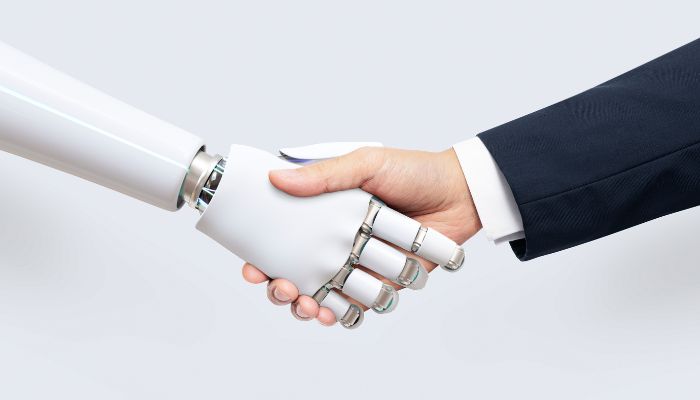
“We overestimate what technology can do in the short run and underestimate what it can do in the long run,” observed futurist Roy Amara, summarising what is now known as Amara’s Law (Beck & Wade, 2004). Nowhere is this more evident than in the deployment of artificial intelligence today. Despite unprecedented investment and attention, AI is largely being used to automate routine tasks and reduce labour costs, delivering short-term efficiency gains but falling far short of its transformative promise. This article argues that AI’s potential is being fundamentally underutilized because organizations are asking the wrong questions—focusing on substitution instead of using AI to solve complex economic and social problems, augment human capabilities, and create long-term value.
Why Current AI Adoption Falls Short of Its Promise
Global investment in AI has surged, with corporate spending crossing hundreds of billions of dollars annually. However, the scale of investment has not translated into the scale of ambition. Most deployments focus on local optimisation rather than systemic transformation.
Several forces drive this pattern. First, short-term financial pressures incentivise visible cost savings over longer-term investments whose payoffs are uncertain and delayed. Second, many organisations lack AI-literate leadership and the data infrastructure needed to deploy AI for complex, cross-functional problem-solving. Third, labour substitution is simply easier than redesigning workflows, reskilling workers, or rethinking business models. In India, these challenges are amplified by infrastructure gaps and uneven readiness. Advanced AI adoption remains limited to a small share of firms, while many organisations remain stuck in pilot phases. As a result, AI is layered onto existing processes rather than used to rethink them.
The Key Questions AI Should Be Addressing Instead
To unlock AI’s real value, organisations and policymakers must reorient their approach around a different set of questions—questions that focus on expansion, not contraction.
- How can AI improve system-level productivity rather than isolated efficiency?
AI excels at analysing complexity across interconnected systems. Rather than automating individual tasks, it can optimise entire supply chains, logistics networks, energy systems, and service ecosystems. These system-level applications enhance resilience, reduce volatility, and drive productivity gains that benefit not just single firms, but entire sectors and economies. - How can AI augment human capability rather than erode it?
When deployed thoughtfully, AI elevates human roles by handling pattern recognition, forecasting, and large-scale analysis. This frees workers to focus on judgment, creativity, supervision, and strategic problem-solving. Conversely, misapplied AI can reduce jobs to residual, low-skill tasks, undermining worker capability and limiting opportunities for growth. - How can AI help solve large-scale social and economic challenges?
Many pressing societal problems—such as unequal healthcare access, agricultural risk, urban congestion, informal work, and climate adaptation—are challenges of coordination and information, not just labour shortages. AI can tackle these issues at scale by improving targeting, predictive accuracy, and resource allocation, creating measurable social and economic impact. - How can AI create new markets and sources of value?
Transformative technologies generate their greatest impact by enabling entirely new products, services, and business models. AI should be evaluated not just on cost reduction, but on its ability to unlock new markets, improve quality, and drive innovation-led growth, creating value that extends beyond immediate operational gains.
What Becomes Possible When AI Is Used Differently
AI’s greatest potential lies in addressing challenges at a systemic level rather than focusing on isolated tasks. By analysing complexity across interconnected systems, it can optimise entire supply chains, logistics networks, energy grids, and service ecosystems, enhancing resilience, reducing volatility, and generating productivity gains that extend beyond individual firms to benefit whole sectors and economies. Beyond efficiency, AI can elevate human capability when thoughtfully deployed, taking over pattern recognition, forecasting, and large-scale analysis, and freeing workers to concentrate on judgment, creativity, supervision, and strategic problem-solving. Misapplied, however, AI risks reducing roles to low-skill residual tasks, eroding worker capability, and growth opportunities.
Furthermore, AI is uniquely positioned to tackle large-scale social and economic challenges—such as unequal healthcare access, agricultural risk, urban congestion, informal work, and climate adaptation—by improving coordination, predictive accuracy, and resource allocation at scale, creating measurable societal and economic impact. Finally, transformative value emerges when AI enables entirely new products, services, and business models, opening markets, improving quality, and driving innovation-led growth rather than being confined to cost-cutting or operational optimisation
The Economic Cost of Asking the Wrong Questions
When AI adoption is narrowly focused on labour substitution, the risks compound. Value creation is limited to cost savings rather than innovation or growth. Displaced workers reduce consumption, weakening demand and reinforcing a cycle of stagnation. Inequality widens as high-skill workers capture AI-related gains while low-skill workers face declining prospects. For India, the macroeconomic stakes are particularly high. AI could contribute significantly to future GDP growth, but only if it supports productivity, job creation, and inclusion. A strategy centred on automation risks undermining labour absorption, weakening domestic demand, and turning the demographic dividend into a demographic liability.
AI is not inherently a force for inclusion or exclusion; its impact depends on the questions we choose to ask. If organisations continue to view AI primarily as a headcount-reduction tool, its transformative potential will remain truncated. If, instead, AI is deployed to solve complex coordination problems, augment human capability, and redesign systems, it can become a powerful engine of sustainable and inclusive growth. The real danger is not that AI will advance too quickly, but that we will continue to aim it too low.