Why the Most ‘Qualified’ Candidates Fail at Work and What We Can Do About It
– By Surbhi Dewan, CHRO, Ashiana Housing Limited
There’s a moment most managers have experienced but rarely admit. You review a resume, top university, impressive internships, certifications stacked like trophies. On paper, this person looks like the answer to your hiring prayers. Fast-forward three months: deadlines missed, communication transactional, initiative absent. How did someone so qualified turn out to be so unprepared? This is the quiet paradox of modern workplaces, the widening gap between resume excellence and workplace effectiveness.
The Resume Is a Highlight Reel, Not a Blueprint
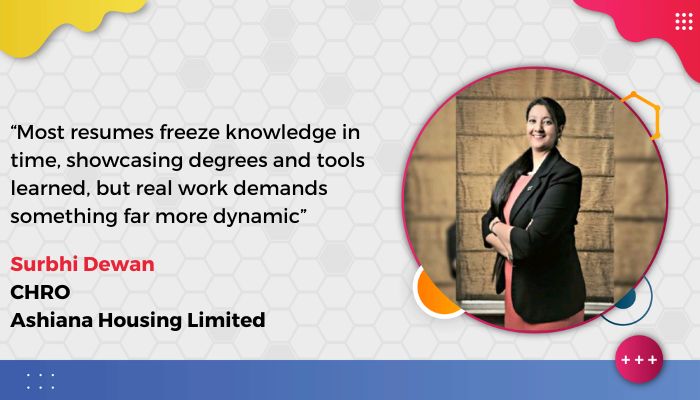
A resume captures what someone has done, not how they operate. It reflects achievements, not adaptability; exposure, not emotional intelligence; knowledge, not judgment. Most resumes freeze knowledge in time, showcasing degrees and tools learned, but real work demands something far more dynamic. In the real world, problems don’t arrive labelled like exam questions. There is no answer key. There are ambiguous situations, incomplete data, difficult stakeholders, and shifting priorities. This is exactly where many “qualified” candidates begin to stumble, not because they lack intelligence, but because they were never tested in conditions that actually mirror work.
High Marks Don’t Equal the Right Fit
There is a widely held assumption in hiring: that domain expertise and academic brilliance are reliable proxies for job performance. They are not. Expertise is context-specific, a brilliant analyst may flounder in a startup demanding cross-functional thinking; a credentialed engineer may struggle in a client-facing role requiring plain communication. Highly intelligent candidates sometimes over-engineer simple problems, struggle with ambiguity, or find it difficult to collaborate with people who think differently. A person who aced every exam may still lack the practical wisdom that comes from navigating real constraints, real people, and real consequences. Fit is about alignment, not just ability. Two candidates with identical qualifications can produce vastly different outcomes depending on the match.
The Emotional Intelligence Gap, and What the Data Shows
One of the biggest reasons qualified candidates underperform is not a lack of technical ability, it’s a lack of emotional intelligence. They know what to do, but not how to navigate people while doing it. A 2019 LinkedIn Global Talent Trends report found that 89% of hiring failures stem from a lack of soft skills. Research by the Carnegie Institute concluded that 85% of financial success comes from people skills, while only 15% is attributed to technical knowledge. As Daniel Goleman emphasized, we effectively have two minds, one that thinks and one that feels. The workplace consistently rewards those who can manage both, yet this skill appears on no GPA and no certification.
The Confidence Trap and the Illusion of Readiness
A strong resume can create an illusion of readiness. Academic success builds an identity: “I am capable because I have achieved.” But the workplace tests a different capability, one that emerges under pressure and in ambiguity. This leads to overpromising, avoidance of unfamiliar challenges, and resistance to feedback. True confidence looks quieter, more grounded. It shows up as the willingness to say, “I don’t know, but I’ll figure it out,” and then actually doing that work.
How Interviews Must Evolve
The conventional interview is broken by design. It rewards polish over substance, and two systemic biases compound this. Sophistication bias means interviewers unconsciously favour confident, jargon-heavy language, even when it conceals shallow thinking. Research by Tsay and Banaji (2011) showed evaluators consistently rate the appearance of talent over demonstrated achievement. Conformity bias means we hire people who look and think like us, reducing diversity and amplifying collective blind spots. To fix this, interviews must assess situations, not scripts. Structured behavioural interviews using the STAR framework predict performance far better than unstructured conversations. Work sample tests rank among the strongest predictors of future performance per Schmidt and Hunter’s landmark meta-analysis. Panel interviews with structured scoring rubrics reduce individual bias. The goal is to make the invisible visible, to surface judgment, adaptability, and character, not just curated accomplishment.
What Organisations Can Do Differently
Organisations are not passive victims of this gap, they actively create it. Job descriptions demanding five years of experience for entry-level roles, and promotions consistently rewarding credentials over contribution, train people to optimise for appearance. To genuinely close the gap, organisations must rewrite job descriptions around outcomes and behaviours, and implement 90-day frameworks that track real integration: does this person ask good questions, build relationships, and seek feedback? Onboarding must build psychological safety, because employees who feel they cannot admit uncertainty will fake competence, fall behind, and leave quietly. Google’s Project Aristotle found that psychological safety is the single greatest predictor of team performance, above any technical skill. That environment must start at hiring, not after.
What Candidates Can Do
For candidates, the most honest advice is this: your resume got you in the room. Now forget it. The qualities that will determine your trajectory, accountability, curiosity, resilience, the ability to read people, cannot be rehearsed in a cover letter. They must be lived. Seek feedback early and specifically, not at annual reviews. Volunteer for ambiguous projects where there is no answer key. Build the habit of reflection, asking after every difficult interaction, “What did I notice about how I responded?” Consider two fresh hires. One holds an MBA and speaks fluent corporate jargon. The other has an average record but constantly asks questions and volunteers for tasks nobody assigned. Three months in, it is almost always the second person who stands out, not because they knew more on day one, but because they were willing to grow every day after.
Reality Has One Simple Rule
The workplace is not an exam hall. It is a dynamic system shaped by people, unpredictability, and constant change. Who you are becoming matters far more than what you have already done. As Warren Buffett noted, the chains of habit are too light to feel until they are too heavy to break. Your daily habits, how you respond, adapt, communicate, and persist, quietly determine your trajectory over time. A resume may get you hired. But reality decides whether you grow, stagnate, or fail. And reality has one simple rule: it does not reward what you claim to know. It rewards how you show up when it actually matters. Organisations, interviewers, and candidates can all choose to close the gap, one honest question, one courageous conversation, and one deliberate habit at a time.
About the Author
Surbhi Dewan is a seasoned HR leader and organizational strategist with over 22 years of experience in building, transforming, and scaling high-performing organizations. Currently serving as CHRO at Ashiana Housing Limited, she operates at the intersection of talent, culture, and business strategy, enabling sustainable growth and performance. An alumna of New York University, Surbhi has led HR across diverse ecosystems, including MNCs, promoter-led enterprises, and startups, navigating critical phases of inception, transformation, and scale.
Her expertise spans leadership hiring, organization design, performance and potential management, capability building, compensation and benefits, and HR tech transformation. She has played a pivotal role in setting up and scaling HR functions across multiple organizations, driving impact through structured people practices and forward-looking strategies. As an ILO Delegate (India) with the Employers’ Federation of India, she brings a global perspective to workforce and policy conversations.
Recognized for her contributions to the HR ecosystem, Surbhi has received several prestigious accolades, including BusinessWorld 40 Under 40, PeopleFirst HR Excellence Award, Emerging L&D Leader, HRAI Women Achievers Award, and PeopleFirst Leading Minds in HR. She remains deeply committed to building organizations that not only perform in the present but are designed to endure and evolve for the future.
Disclaimer: The opinions and views expressed in this article, including any accompanying data, are the sole responsibility of the author and should not be construed as reflecting the official policy or position of India Employer Forum.