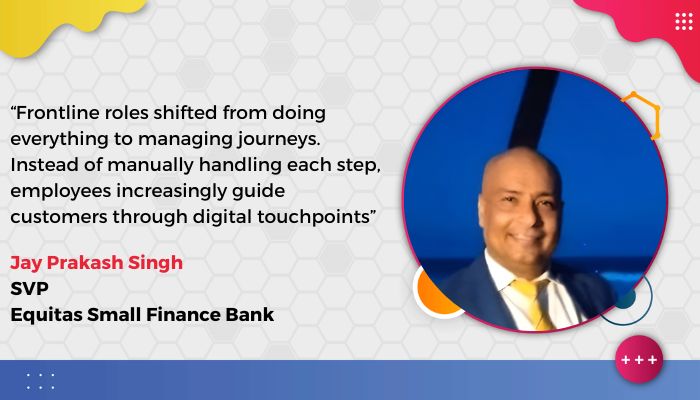
By Jay Prakash Singh, SVP, Equitas Small Finance Bank
For decades, frontline productivity in India was understood in simple terms: more effort meant more output. Longer hours, wider coverage, and deeper personal networks were seen as the primary drivers of performance. But that definition no longer holds.
Today, frontline productivity has fundamentally transformed. It is no longer a function of how hard people work, but of how intelligently work is designed, prioritised, and enabled by systems. Understanding this evolution is critical for leaders navigating today’s complex operating environment.
The Manual Era (Pre-2005): When Effort Defined Output
In the early years of organised frontline operations, productivity was almost entirely human-dependent. Relationship managers, sales executives, and field officers relied on physical visits, paper-based processes, and personal rapport to get work done. Customer information was fragmented, often stored in notebooks or personal memory rather than systems.
Output followed a linear path, more visits led to more conversations, which occasionally led to conversions. Efficiency was low, and scalability was limited. Yet, relationships ran deep. Trust was built face-to-face, and frontline roles carried a strong sense of ownership.
Success in this era was straightforward: hard work combined with a strong personal network often determined results. Systems played a minimal role; people were the system.
The Process Optimisation Era (2005–2015): Scale Enters the Equation
The next shift came with the introduction of structured processes. Core systems, early CRMs, and standard operating procedures began to shape frontline work. Organisations started measuring productivity through tangible metrics, turnaround time, conversion ratios, activity counts, and pipeline movement.
This period marked the beginning of scale. Sales and service models became more standardised, enabling organisations to expand faster across geographies. Basic segmentation allowed teams to prioritise certain customer groups over others, while reporting brought visibility into frontline performance.
Productivity improved, not because frontline workers exerted more effort, but because work became more organised. However, success still depended heavily on volume. Doing more activities within a defined process framework was the primary lever.
In this phase, success was driven by process adherence and throughput.
The Digital Acceleration Era (2015–2022): Speed Becomes the Advantage
The next transformation was powered by digital acceleration. Mobile platforms, digital onboarding, analytics, and remote servicing redefined how frontline work was executed. Physical visits reduced, acquisition cycles shortened, and inside sales models gained prominence.
Frontline roles shifted from “doing everything” to “managing journeys.” Instead of manually handling each step, employees increasingly guided customers through digital touchpoints. Speed became a competitive advantage. Faster onboarding, quicker approvals, and instant communication redefined customer expectations.
Productivity gains were significant. The same frontline team could now handle far higher volumes, supported by digital tools. However, this era also increased pressure. Faster cycles often meant tighter targets, higher monitoring, and greater cognitive load on employees.
Success during this phase was driven by speed and funnel efficiency.
The Intelligence Era (2022–Present): Precision Redefines Productivity
The current era marks the most fundamental shift yet. AI, automation, and predictive analytics have changed the nature of frontline productivity altogether. Output is no longer linear. With the same effort, frontline teams can now generate three to five times the impact, if guided by intelligent systems.
Today’s frontline is increasingly supported by lead scoring models, next-best-action engines, real-time dashboards, and hyper-personalised offerings. Decisions that once depended on instinct or experience are now informed by data.
Productivity is no longer about doing more; it is about doing the right things at the right time. Prioritisation has become the most valuable skill. Two frontline employees exerting the same effort can produce vastly different outcomes depending on how well systems guide their actions.
Success in this era is defined by decision quality, focus, and timing.
The Shift That Defines the New Frontline
Over time, the nature of frontline productivity has undergone a clear transition:
- From activity-driven work to outcome-driven impact
- From volume focus to value creation
- From gut-based decision-making to data-led action
- From individual effort to system-enabled performance
This is not merely a technological shift, it is a structural one. Productivity is now embedded in how work is designed, sequenced, and supported, rather than in how much effort individuals exert.
The Real Insight Many Leaders Miss
Despite this transformation, many organisations still manage frontline productivity using outdated assumptions. Targets are increased, headcount is added, and activity is pushed harder, without questioning whether the system is guiding frontline effort effectively.
The real question today is no longer, “How much is our frontline doing?”
It is, “How well does our system decide what the frontline should do?”
When prioritisation is poor, even the most capable teams underperform. When systems surface the right opportunities, average performers often excel. Productivity, therefore, sits less with people alone and more at the intersection of people, data, and decision architecture.
What This Means for Leaders Today
For leaders, especially CHROs and business heads, this evolution demands a reset in thinking.
Hiring for adaptability is now more critical than hiring for experience alone. Frontline roles are changing too fast for static skill sets to remain relevant.
Investment must shift from expanding team size to strengthening tools, analytics, and decision engines. A smaller, better-enabled workforce often outperforms a larger, poorly guided one.
Coaching must focus less on activity levels and more on prioritisation, why certain leads matter more, when to intervene, and how to sequence effort.
Finally, leaders must design journeys rather than merely track numbers. When workflows are thoughtfully designed, productivity becomes a natural outcome rather than a forced target.
Closing Thought: The Future of Frontline Performance
The future frontline performer will not be the hardest worker in the room. It will be the one who knows where to focus, whom to target, and when to act, supported by intelligent systems that remove noise and sharpen judgment.
For organisations, the competitive edge will not come from pushing frontline teams harder, but from enabling them to work smarter. Productivity, in its truest form, has moved from effort to intelligence, and leaders who recognise this shift will define the next decade of frontline performance.
As Senior Vice President at Equitas Small Finance Bank, Jay Prakash Singh leads liabilities sales for the North Zone, with a strong focus on driving top-line growth and improving operational throughput. With over nine years at the organisation, he oversees the gold loan portfolio and steers strategic sales initiatives across key regions including Delhi, Punjab, Haryana, Uttar Pradesh, Rajasthan, Uttarakhand, Madhya Pradesh, and Chhattisgarh. Working closely with a team of nearly 800 field professionals and a committed leadership group, he plays a pivotal role in enhancing productivity, strengthening customer satisfaction, and deepening the bank’s market presence. His leadership approach emphasises collaboration, value creation for clients, and execution excellence, earning him multiple recognitions for performance and impact.
Disclaimer: The opinions and views expressed in this article, including any accompanying data, are the sole responsibility of the author and should not be construed as reflecting the official policy or position of India Employer Forum.