by Pukhraj Joneja
Most organisations fail not because the strategy was wrong, but because the soul of the company had already left the body while still alive.
For decades, the corporate playbook read like a grey narrative: maximize shareholder value, optimize the P&L, reset, and repeat. If culture was in the room at all, it was the “background music”—hard to notice and even easier to ignore. But after two decades of engineering turnarounds and scaling businesses across travel, hospitality, and global mobility, I’ve learned a different truth: Profit is the fuel, but purpose is the engine. If your organisation lacks a credible purpose, you aren’t leading—you’re just managing a well-documented decline.
Balance Sheet – Induced Blindness
We’ve all been in those meetings—the ones I call “Numb & Number.” The dashboards look magnificent if the margins are smiling, and the room feels eerily calm (or agitated, depending on which side of the table you’re sitting on). All the KPIs check out, yet the creative energy required to save a company in a crisis is on permanent vacation.
This is the “Execution Paradox.” Leaders often mistake numerical discipline for organizational health. But a P&L can only tell you what happened yesterday; it cannot tell you if your team will fight for you tomorrow when you need it the most.
During a high-growth phase leadership review, a young leader once dropped a truth bomb in the room that permanently recalibrated my perspective. He said:
“We know exactly what the targets are. We just don’t know why they really matter.”
Targets train the head; purpose activates the soul. When people know the why, work
becomes a commitment. When they don’t, it remains mere compliance. In a volatile market, you cannot survive on numerical discipline alone; you need the grit that only comes from conviction.
The P&L of the Purpose (Yes—the Numbers)
If this sounds too “soulful,” the pragmatic reality is that the data is now indisputable. Purpose is not a soft cost; it is structural leverage that quietly shapes every line on your financial statement. In the current 2026 landscape, the correlation between “Conscious Culture” and “Alpha Returns” is a matter of record:
- Profitability Alpha: Top-quartile business units in engagement deliver 23% higher profit than bottom-quartile units (Gallup).
- The Retention Hedge: Purpose-driven cultures report markedly higher retention—a vital shield against replacement costs that can exceed 100–200% of a senior role’s annual salary.
- Performance Uplift: High belonging correlates with a 50% increase in job performance and a 75% reduction in sick days.
- Market Outperformance: Firms recognized as “great workplaces” outperform the market materially over time, often by a factor of 2–3x.
Culture with a purpose, it turns out, is the most undervalued asset on your balance sheet.
Culture Is What You Tolerate
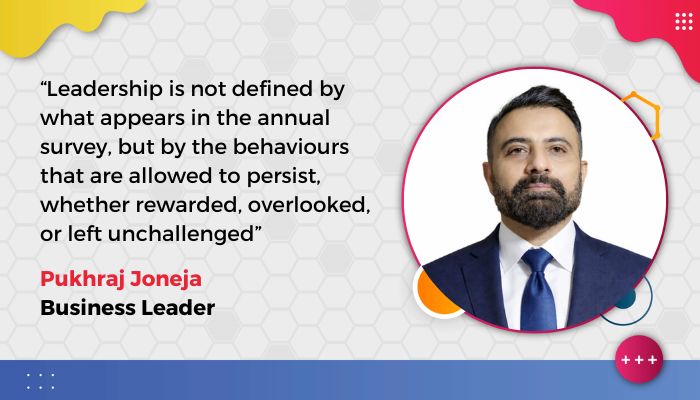
We all know too well that real culture isn’t found on motivational posters or office perks. It is the sum of what you reward, what you ignore, and—most dangerously—what you tolerate. Leadership is not defined by what appears in the annual survey, but by the behaviours that are allowed to persist, whether rewarded, overlooked, or left unchallenged.
I once worked with a leader who, before approving any major pivot, would ask: “Is this aligned with who we say we are and our larger purpose?” That simple manual override stopped a dozen short-term, reputation-eroding decisions. If your compensation structures reward “volume at any cost,” your people will always believe the instant gratification of the P&L over the mission statement on the wall.
The Chai-Sandwich Strategy: Trust as Efficiency
In one turnaround, we faced a recurring operational defect that was bruising our reputation more than our revenue. Instead of a six-month task force of high-priced consultants, we sat down with the frontline, bought chai- sandwiches, and asked: “What’s the single smallest change that will stop this next week?”
They fixed the deluge in 72 hours.
The lesson? The people closest to the work often hold the simplest solutions—provided you trust them to act. Trust is not a charitable act; it is the “cheese in your sandwich” that makes everything hold together. When you remove the friction of distrust, you increase the velocity of your business. Trust is, quite literally, operational efficiency.
My Compact Leadership Playbook: C.U.L.T.U.R.E.
To translate “purpose” into organisational behaviours, I utilize this framework:
- C — Clarity of Purpose: A one-sentence North Star explaining why you exist beyond revenue. In mobility, we don’t just process paperwork; we facilitate global dreams.
- U — Unified Leadership: Alignment at the top ensures purpose becomes part of daily decision-making. Friction at the top leads to fractures at the bottom.
- L — Learn & Lean: Treat failure as data; accelerate the learning loop and lean on your team when in a crisis. Resilience is a team sport.
- T — Transparency: Transparency leads to trust, and trust speeds up decisions. In a conscious organisation, the “why” behind a decision is as important as the decision itself.
- U — Understand Stakeholders: Balance employees, customers, partners, and investors in one model. A win for the shareholder that is a loss for the employee is a long-term failure.
- R — Recognise: Notice, name, and reward the behaviours you want repeated. Culture is built one “thank you” at a time.
- E — Empower: As the adage goes: make people hireable enough to leave, but treat them well enough that they’d like to stay.
The Leadership Imperative
Purpose isn’t soft—it’s selective. It helps you say “No” to profitable but toxic opportunities. It focuses capital, time, and talent on what truly matters, tightening the aperture for execution.
As we navigate 2026, the best leaders treat culture as a measurable asset. They understand that the “war for talent” has ended, and talent won. People are no longer just evaluating compensation packages; they are evaluating the “Why.”
Ask yourself: Do people here know why their work matters—and is that why they stay?
If the answer is yes, you’re indeed building a conscious organisation. Congratulations !
Stop managing for the scoreboard and start leading for the purpose. Short-term profit may be the gratifying oasis, but finally, it’s the purpose that keeps you true to where
you’re going, and it’s the culture that keeps you focused and—most importantly—happy. After all, you do want to keep the soul in the body, don’t you?
About Pukhraj Joneja
Pukhraj Joneja is a seasoned business leader with a strong track record of driving growth, building high-performing teams, and leading strategic initiatives across dynamic markets. He brings deep expertise in sales, business development, and customer-centric operations, with a consistent focus on delivering sustainable value and innovation. Known for his strategic mindset and collaborative approach, Pukhraj is passionate about leveraging insights and technology to solve complex business challenges while continuously adapting to an ever-evolving business landscape.
Disclaimer: The opinions and views expressed in this article, including any accompanying data, are the sole responsibility of the author and should not be construed as reflecting the official policy or position of India Employer Forum.